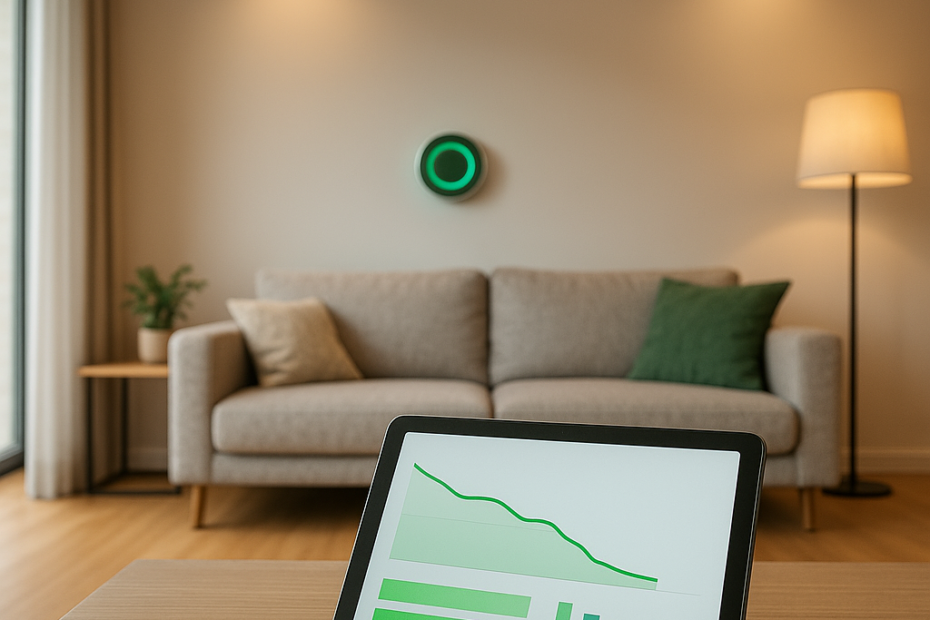
Energy bills have a way of quietly climbing higher every year, and for many homeowners, that creeping increase feels almost inevitable. But here’s the thing — it doesn’t have to be. Smart home technology has matured significantly over the past decade, moving far beyond novelty gadgets and voice-activated light switches into a genuinely powerful ecosystem that can meaningfully reduce how much energy a home consumes. The potential savings aren’t trivial either. According to the U.S. Department of Energy, smart thermostats alone can save homeowners up to 10–12% on heating costs and around 15% on cooling costs annually. Multiply that across lighting, appliances, and energy monitoring systems, and the cumulative impact becomes hard to ignore.
This article breaks down exactly how integrating smart home technology leads to lower energy bills — not in theory, but in practical, everyday terms.
Understanding the Link Between Smart Technology and Energy Efficiency
Before diving into specific devices and systems, it helps to understand why smart technology reduces energy use in the first place. The short answer is: awareness and automation. Most energy waste in a home happens passively — lights left on in empty rooms, HVAC systems running at full capacity when no one’s home, appliances drawing standby power around the clock. Traditional homes offer no real mechanism to address these habits automatically.
Smart home technology changes that equation in two key ways:
- Real-time monitoring gives homeowners visibility into exactly where and when energy is being consumed, making it easier to identify waste.
- Automation removes the reliance on human behavior by letting systems adjust themselves based on schedules, occupancy, or environmental conditions.
Together, these two forces create a home that responds intelligently to how it’s actually being used, rather than operating on default settings that were never optimized for efficiency.
Smart Thermostats: The Biggest Bang for Your Buck
If there’s one smart home upgrade that delivers the most immediate and measurable return on energy savings, it’s the smart thermostat. Heating and cooling typically account for around 43% of a home’s total energy use, according to the U.S. Energy Information Administration — making HVAC the single largest opportunity for savings.
Smart thermostats like the Google Nest, Ecobee, and Honeywell Home T9 go well beyond programmable scheduling. They learn household routines over time, use geofencing to detect when residents leave or return home, and adjust temperatures accordingly — automatically. Some models integrate with local weather forecasts to pre-condition a home before temperatures rise or drop, avoiding the energy spike that comes with bringing a stuffy or cold house back to a comfortable temperature all at once.
How Much Can a Smart Thermostat Actually Save?
The numbers here are well-documented. Ecobee reports that its smart thermostats save users an average of 26% on heating and cooling costs compared to holding a constant temperature. Google Nest has published data suggesting savings of approximately $145 per year for the average U.S. household. These figures vary depending on climate, home size, and prior habits, but even at the conservative end, the device typically pays for itself within the first year of use.
The key insight is that these savings compound over time. A smart thermostat isn’t a one-time optimization — it continues learning, adapting, and refining its behavior as it gathers more data about how a household operates.
Smart Lighting Systems and Energy Savings
Lighting accounts for roughly 15% of a home’s electricity use, according to Energy Star. Smart lighting addresses this through a combination of LED efficiency, occupancy detection, and automated scheduling — often cutting lighting-related energy consumption by 50–75% compared to traditional incandescent setups.
The most impactful feature of smart lighting isn’t the ability to control bulbs from a phone — it’s the automation. Motion sensors can turn lights off in rooms that have been empty for a set period. Schedules can dim or shut off lights at certain hours. Daylight sensors can automatically reduce artificial lighting when natural light is sufficient.
Smart Lighting Beyond the Bulb
Beyond individual smart bulbs, whole-home lighting systems like Lutron Caseta or Philips Hue offer scene-setting capabilities that are inherently energy-conscious. A “movie night” scene, for instance, might dim lights to 20% across three rooms rather than leaving full-brightness overheads on. A “goodnight” scene shuts off every light in the house with a single command or tap — eliminating the late-night walk through the house to check every switch.
Smart plugs and outlets extend this concept to lamps and decorative lighting that wouldn’t otherwise be controllable, adding automation layers even to older fixtures. For homeowners looking to pair these upgrades with a more refined interior feel, simple upgrades for a sophisticated space can complement the functional benefits of smart lighting with aesthetic improvements throughout the home.
Energy Consumption Monitoring and Smart Home Energy Management Systems
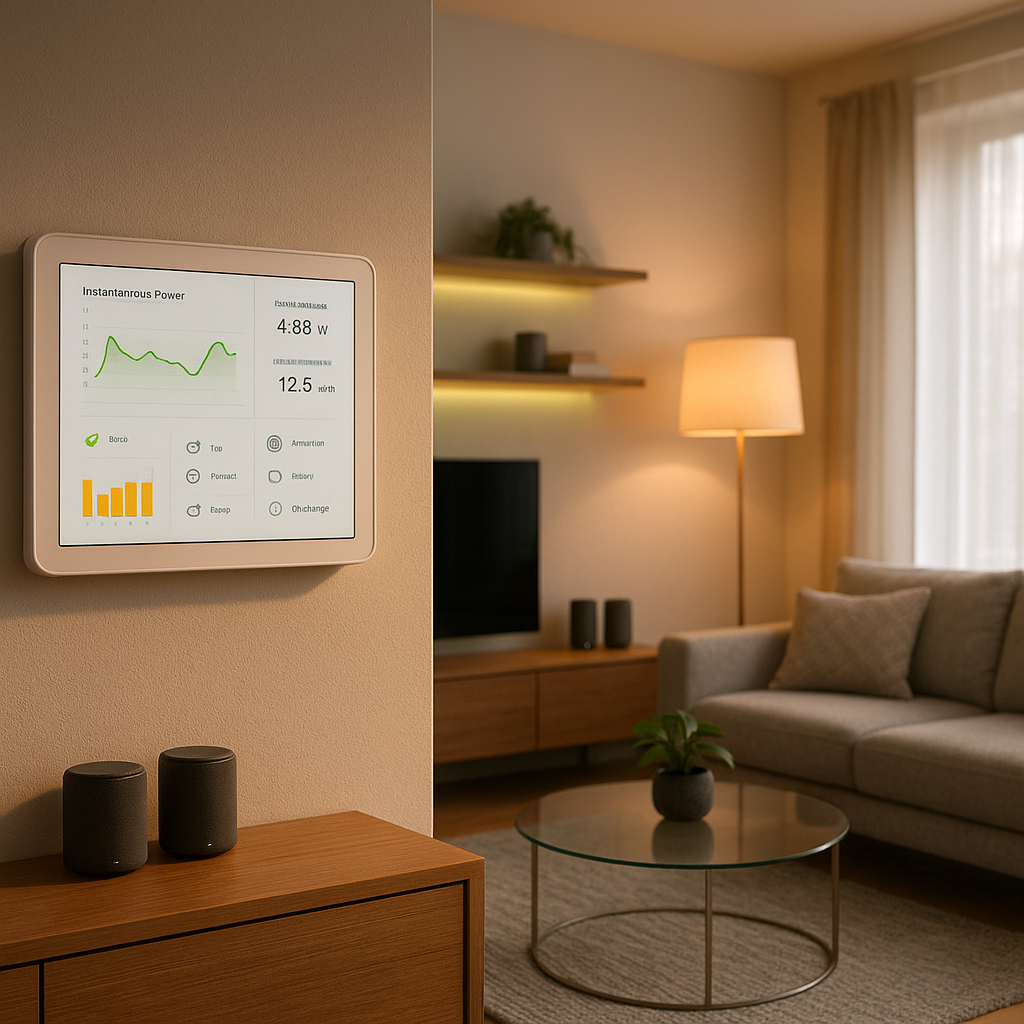
One of the most underutilized tools in smart home energy efficiency is whole-home energy monitoring. Devices like the Sense Energy Monitor or Emporia Vue install directly into the home’s electrical panel and provide circuit-level insight into energy consumption — often breaking down usage by individual appliance through machine learning.
This level of visibility is genuinely transformative. Many homeowners are surprised to discover that older refrigerators, pool pumps, or electric water heaters are consuming far more energy than expected. Without this data, those inefficiencies are invisible — and therefore never addressed.
What Is a Smart Home Energy Management System?
A smart home energy management system (SHEMS) is an integrated platform that connects multiple smart devices — thermostats, lighting, appliances, solar panels, battery storage — under a unified control layer. Rather than managing each device independently, a SHEMS coordinates them to minimize overall energy consumption and cost.
For example, a SHEMS might know that electricity rates are lower between 10 PM and 6 AM (a common time-of-use pricing window offered by many utilities). It could automatically schedule the dishwasher, EV charger, and water heater to run during those off-peak hours, reducing the monthly bill without any manual input from the homeowner.
Some systems also integrate with solar panel arrays and home battery storage, prioritizing stored solar energy during peak-rate hours and drawing from the grid only when rates are favorable. This kind of intelligent load shifting represents the cutting edge of residential energy management.
Smart Appliances and Their Role in Reducing Energy Use
Major appliances — refrigerators, dishwashers, washing machines, dryers — represent a significant portion of household energy consumption. Modern smart appliances bring a layer of connectivity that traditional appliances simply can’t match.
Many Energy Star-certified smart appliances can now communicate with utility companies directly through demand response programs. When the grid is under heavy load and electricity prices spike, these appliances can automatically delay or reduce their operation — sometimes earning the homeowner bill credits in return.
- Smart refrigerators can optimize compressor cycles based on usage patterns and ambient temperature.
- Smart washing machines and dryers allow remote scheduling to run during off-peak hours.
- Smart water heaters can be programmed to heat water only when demand is anticipated, rather than maintaining a constant temperature throughout the day.
- Smart power strips eliminate vampire draw by cutting standby power to electronics that aren’t in use.
Integration: Why the Whole Is Greater Than the Sum of Its Parts
Individual smart devices deliver savings on their own. But the real power of smart home technology emerges when these devices are integrated into a cohesive system. A fully connected smart home doesn’t just automate individual functions — it coordinates them.
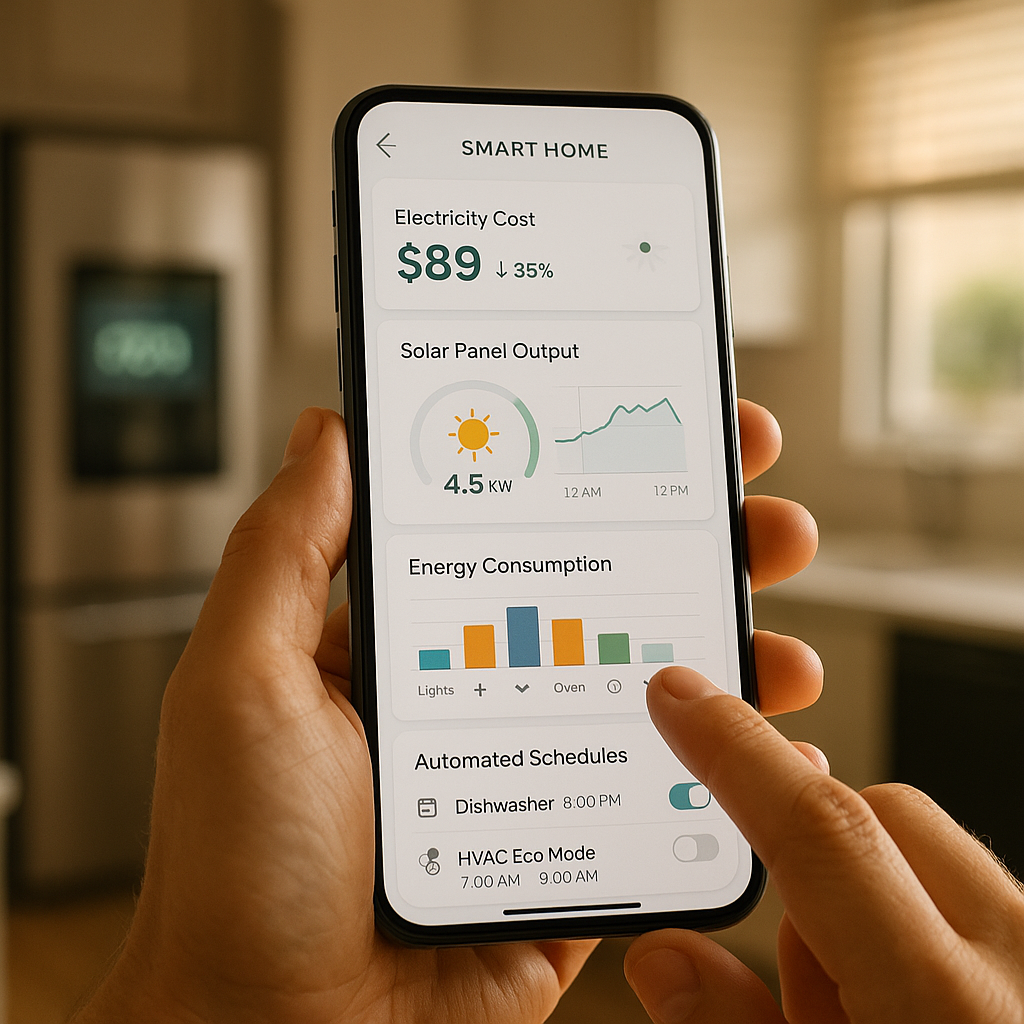
Consider this scenario: A homeowner leaves for work. Their phone’s location triggers a geofence, which signals the smart thermostat to enter energy-saving mode, the smart lighting system to turn off all lights, and the smart plugs to cut power to non-essential devices. Later that afternoon, the system detects through geofencing that the homeowner is 20 minutes away and begins warming the house back to the preferred temperature — using only the energy needed to restore comfort by arrival, nothing more.
This kind of coordinated response isn’t science fiction — it’s available today through platforms like Google Home, Amazon Alexa, Apple HomeKit, and SmartThings. The key is choosing devices that communicate with one another, either through a common protocol like Matter (a relatively new universal smart home standard) or through a single manufacturer’s ecosystem.
Does Smart Home Technology Really Save Energy? What the Research Says
Studies consistently confirm the energy-saving potential of smart home integration. Research published through the American Council for an Energy-Efficient Economy (ACEEE) has found that connected home technologies have the potential to reduce U.S. residential energy use by 5–10% in the near term, with higher savings achievable as adoption grows and systems become more sophisticated.
A European study referenced by KNX Association found that smart home control systems reduced energy consumption in monitored households by an average of 30–40% over time — driven primarily by improved HVAC management and lighting automation. These figures align with what individual device manufacturers report and what independent testing has confirmed across diverse climates and home types.
Getting Started: A Practical Approach to Smart Home Integration for Energy Savings
For homeowners interested in reducing energy costs through smart technology, the process doesn’t have to be overwhelming or expensive. A phased approach typically works best:
- Start with a smart thermostat. It offers the highest return on investment and the lowest barrier to entry. Installation typically takes under an hour and requires no special technical knowledge.
- Add smart lighting gradually. Begin with high-traffic areas like the living room, kitchen, and hallways where lights are most frequently left on.
- Install an energy monitor. Understanding current consumption patterns helps identify the next most impactful upgrades.
- Explore smart plugs for high-draw devices. Televisions, game consoles, and desktop computers are common culprits for standby energy waste.
- Consider a smart home hub or platform to tie devices together as the ecosystem grows. It’s also worth evaluating the home’s building envelope at this stage — factors like a properly layered roof can significantly affect how hard HVAC systems have to work, making smart technology even more effective.
One important consideration: look for devices that support the Matter standard or are compatible with the smart home ecosystem already in use. Compatibility issues between devices are one of the most common frustrations in smart home setups, and choosing interoperable hardware from the beginning avoids a lot of headaches down the road.
Conclusion
Smart home technology has evolved into a genuinely practical tool for reducing household energy consumption — not just a collection of convenient gadgets. From smart thermostats that learn daily routines and adjust HVAC usage accordingly, to whole-home energy monitors that expose hidden inefficiencies, to integrated systems that coordinate every device under a single intelligent framework, the opportunities for meaningful savings are substantial and well-supported by research.
The core principle underlying all of it is simple: a home that understands how it’s being used can stop wasting energy on moments when no one needs it. Smart lighting turns off automatically. Heating and cooling scale back when the house is empty. Appliances shift their heaviest loads to off-peak hours. Standby power draw gets eliminated at the source. Each of these improvements is modest on its own, but together they can reduce annual energy costs by hundreds of dollars — and that impact grows as more devices are added and better integrated over time.
For homeowners looking to take meaningful control of their energy bills, smart home technology represents one of the most actionable and well-documented paths forward available today.