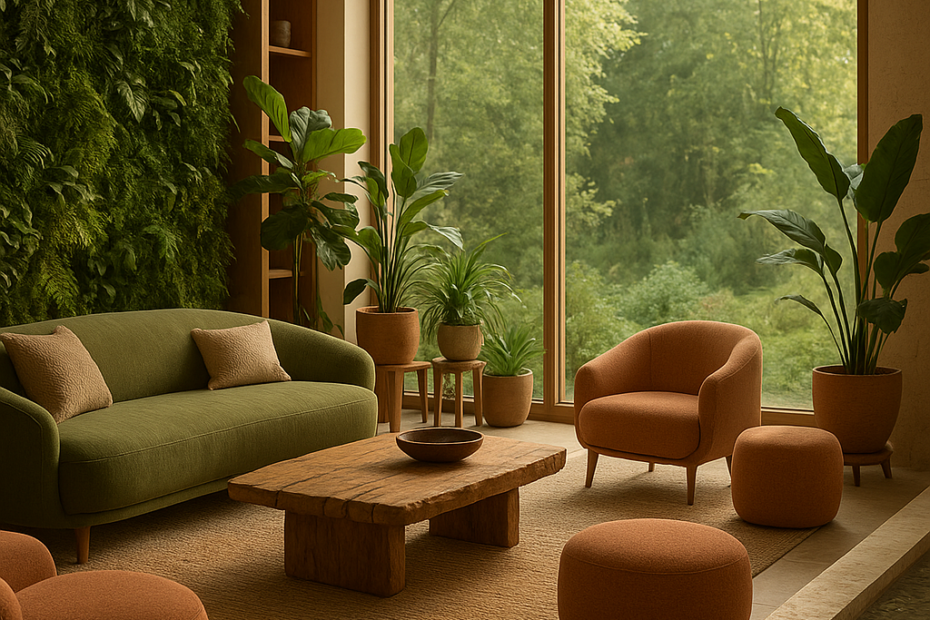
There’s something deeply satisfying about walking into a room that feels alive — where the light shifts gently, plants breathe quietly in corners, and natural textures invite you to slow down. That feeling has a name: biophilic design. More than just a trend, it’s a philosophy rooted in our innate human need to connect with the natural world, even when we’re indoors. As homes become more central to our daily lives, understanding how to weave nature into living spaces has never felt more relevant or more transformative.
Biophilic design draws from the concept of biophilia — a term popularized by biologist E.O. Wilson in 1984 — which describes the instinctive bond humans share with other living systems. When applied thoughtfully to interior design, these principles don’t just make a home look beautiful; they actively support mental wellbeing, reduce stress, and improve how we feel in our spaces day to day. Studies have shown that exposure to natural elements can lower cortisol levels, improve concentration, and even speed up recovery from illness. That’s not a small thing when it comes to the places we call home.
This article breaks down the core principles of biophilic design, how they apply to residential spaces, and practical ways to bring them into any home — whether you’re working with a sprawling open-plan layout or a compact apartment.
What Are the Key Principles of Biophilic Design?
Biophilic design is typically organized around a set of core principles that guide how natural elements are integrated into built environments. While different frameworks exist — some citing six principles, others referencing 14 patterns — most converge on three broad categories: nature in the space, natural analogues, and nature of the space. Together, these form a holistic approach that goes far beyond placing a plant on a windowsill.
1. Direct Nature: Bringing the Outdoors In
The most intuitive principle involves incorporating literal, living nature into your home. This includes houseplants, water features, natural light, fresh air, and even animals. But the key to making this principle work is consistency and intentionality — nature isn’t an accessory, it’s a participant in the space.
- Plants: Grouping plants at varying heights creates a layered, forest-like effect that feels more immersive than a single pot on a shelf. Consider trailing vines, large-leafed tropicals, and small tabletop varieties together.
- Water: A small indoor fountain, a wall-mounted water feature, or even a simple fishbowl introduces sound and movement — two elements that are deeply calming to the human nervous system.
- Natural light: Maximizing daylight isn’t just practical — it’s biological. Natural light regulates our circadian rhythms and affects mood significantly. Sheer curtains, mirrors, and light-colored walls can all help distribute light throughout a space.
- Ventilation and scent: Opening windows to allow natural airflow, or using unscented beeswax candles and dried botanicals, connects a room to the outside world in subtle but powerful ways.
2. Indirect Nature: Natural Analogues and Materials
Not every home can have a living wall or a koi pond — and that’s perfectly fine. The second major principle covers natural analogues: materials, textures, colors, and patterns that evoke nature without requiring it to be physically present.
This is where the design choices get deeply interesting. The human brain responds to organic shapes, natural textures, and earth tones in measurable ways — recognizing them as safe, restorative, and familiar. This is why a rough linen cushion feels more comforting than a synthetic one, or why a wood dining table tends to make a room feel warmer than a glass one.
- Natural materials: Wood, stone, rattan, bamboo, cork, and clay are all grounding materials that bring warmth and texture to a space. Using them in their less-processed forms — think live-edge wood or honed rather than polished stone — keeps them feeling close to their origins.
- Organic patterns: Leaf prints, botanical artwork and natural imagery all carry the visual language of nature. These can be introduced through wallpaper, textiles, ceramics, or decorative objects.
- Earth tones: Color palettes drawn from nature — mossy greens, warm ochres, soft terracottas, sandy neutrals — support a sense of groundedness and calm. These aren’t just aesthetically pleasing; they actively reduce visual stress.
- Fractal patterns: Research from the University of Oregon suggests that fractal patterns — the self-repeating geometric structures found in ferns, snowflakes, and coastlines — reduce stress by up to 60%. Introducing them through art, textiles, or architectural details can have a genuine physiological effect.
3. Nature of the Space: How Rooms Feel, Not Just Look
The third principle is perhaps the most nuanced and the most overlooked in home design. It’s about spatial experiences inspired by nature — how a room makes you feel physically and psychologically, rather than what’s visually present.
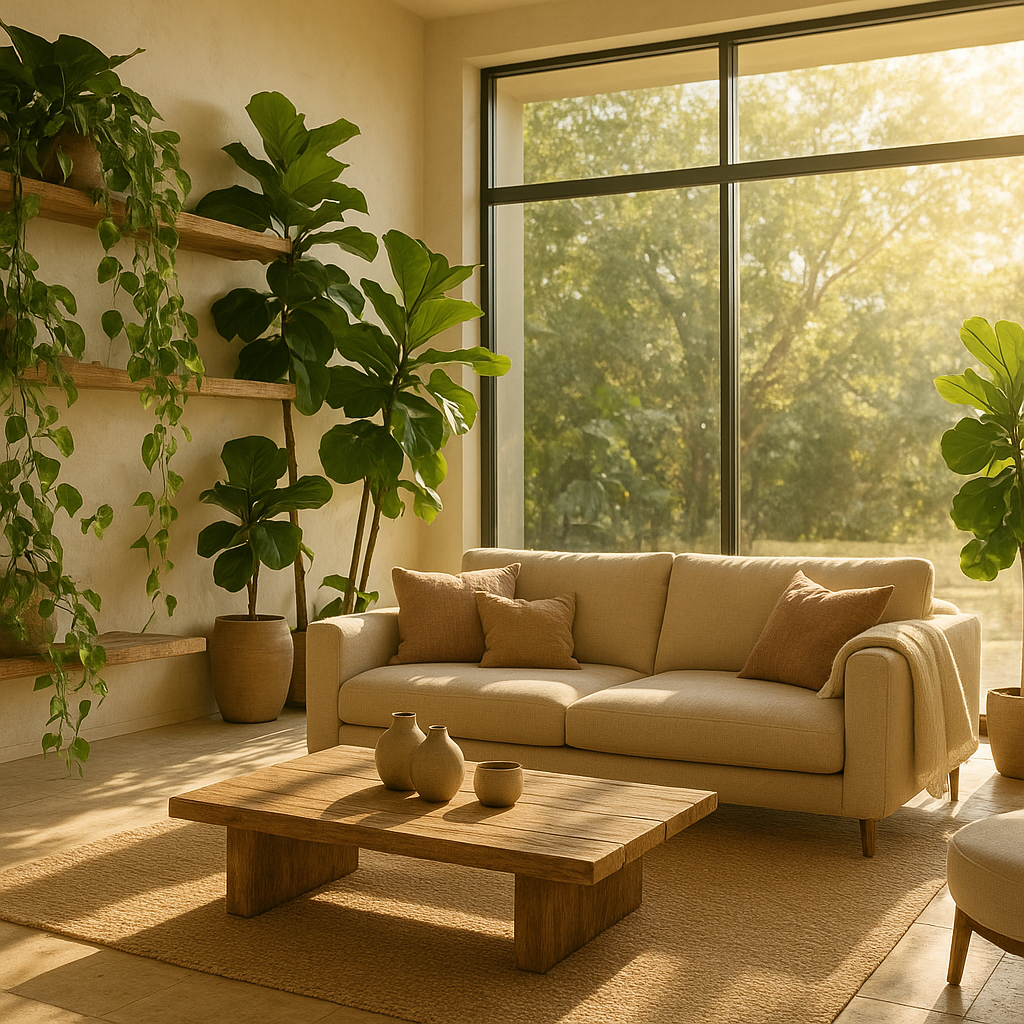
Think about how you feel at the edge of a forest, looking out over a meadow. Or tucked into a cave, sheltered and hidden. These primal spatial experiences — prospect, refuge, mystery, and risk — translate surprisingly well into interior design.
- Prospect and refuge: Humans naturally seek spaces that offer both a wide view (prospect) and a sense of shelter (refuge). A reading nook tucked under a staircase, or a window seat that overlooks a garden, satisfies both instincts simultaneously. Designing spaces with layers — open areas and cozy retreats — supports this balance.
- Mystery and complexity: Spaces that reveal themselves gradually — a hallway that curves, a room visible through a planted screen — engage curiosity and encourage exploration. Too much visual exposure all at once can actually feel tiring.
- Connection between inside and outside: The visual and physical transition between interior and exterior spaces matters enormously. Glass doors that open onto a patio, a kitchen window that looks directly into a herb garden, or floor-level windows that frame ground-level plantings — all of these blur the boundary in deeply satisfying ways.
- Variation in sensory experience: Nature is never monotonous. A biophilically designed room will have variation in light levels, textures, temperatures, and even sounds. This sensory richness keeps our nervous systems engaged without being overwhelmed.
Examples of Biophilic Design in Homes
Biophilic design doesn’t require an architectural overhaul or a significant budget. Some of its most effective expressions are remarkably simple. Here are examples across different rooms of the home:
Living Room
A living room designed with biophilic principles might feature a statement fiddle-leaf fig in a terracotta planter, a jute area rug, linen upholstery in a warm neutral, and a coffee table made from reclaimed wood. Wall art could feature botanical illustrations or abstract works inspired by natural landscapes. If the room allows, a large window left unobstructed becomes the focal point — letting the garden or sky do their quiet work.
Bedroom
In the bedroom, biophilic design leans into calm and restoration. Organic cotton or linen bedding in soft earth tones, a small cluster of low-maintenance plants like snake plants or pothos, blackout curtains that mimic the darkness of night, and wooden or rattan furniture all support better sleep and a sense of sanctuary. The avoidance of synthetic materials and harsh lighting is just as important as what is included.
Kitchen and Dining Areas
The kitchen is one of the most natural rooms to apply biophilic thinking. A countertop herb garden serves both function and beauty. Stone countertops, wooden cutting boards, handmade ceramic dishes, and wicker storage baskets all bring texture and warmth. A dining table positioned near a window — ideally with a view of plants or sky — transforms mealtimes into something more restorative.
Bathroom
Bathrooms are frequently underestimated as spaces for biophilic design. But consider: a wall of pebble tile, a bamboo bath mat, a trailing pothos on a shelf, and a skylight or frosted window that still lets in daylight. Even the sound of water — which the bathroom naturally provides — becomes a biophilic element when approached consciously.
The 9 Values of Biophilia: Understanding Our Relationship with Nature
American biologist and naturalist Stephen Kellert expanded on Wilson’s original concept of biophilia by identifying nine core values that describe how humans relate to the natural world. These aren’t design principles per se, but they help explain why nature-connected spaces feel so deeply right:
- Utilitarian: Nature as a source of practical resources
- Naturalistic: The pleasure of direct interaction with nature
- Ecologistic-scientific: The desire to study and understand natural systems
- Aesthetic: A deep appreciation of nature’s beauty and harmony
- Symbolic: The use of nature in language, metaphor, and meaning
- Humanistic: Strong emotional bonds with specific animals or places in nature
- Moralistic: A sense of ethical responsibility toward the natural world
- Dominionistic: The urge to master or control aspects of nature
- Negativistic: Fear or awe in relation to nature’s power
For home design purposes, the aesthetic, naturalistic, and symbolic values are most directly applicable. Recognizing these deeper motivations helps explain why certain design choices resonate so profoundly — and why others feel hollow despite incorporating superficially “natural” elements.
Common Mistakes to Avoid in Biophilic Home Design
Like any design philosophy, biophilic design can be misapplied. A few common missteps are worth being aware of:
- Treating plants as decorations rather than living systems: Plants that are clearly struggling, dying, or placed in spaces with no natural light undermine the entire effect. Choose species suited to your light conditions and commit to their care.
- Overdoing it: A home crammed with every natural element — excessive greenery, too many patterns, every surface covered in wood — can feel overwhelming rather than calming. Biophilic design is about considered choices, not maximalism.
- Ignoring maintenance: Natural materials require upkeep. Wood needs oiling, stone can stain, and plants need watering. Choosing materials and living elements you’re genuinely prepared to care for is essential.
- Focusing only on aesthetics: If the sensory and spatial dimensions — light quality, air flow, view connections — are ignored in favor of purely visual choices, the deeper benefits of biophilic design won’t be fully realized.
Practical First Steps for Any Home
If biophilic design is new territory, starting small and building gradually is entirely valid. Here are accessible entry points:
- Swap synthetic soft furnishings for natural fiber alternatives — linen, wool, cotton, jute
- Introduce at least three plants to your main living area, varying their heights and leaf shapes
- Audit your window treatments — are they blocking more light than necessary?
- Replace one or two synthetic materials in a room with a natural equivalent
- Create one “refuge” area — a chair tucked into a corner with a reading lamp — to satisfy the prospect-refuge dynamic
- Add a small tabletop water feature to a bedroom or living room for ambient sound
Bringing It All Together
Biophilic design isn’t a checklist to complete or a style to copy — it’s a way of thinking about home that starts with a fundamental question: does this space support my connection to the natural world? When the answer is yes, the effects ripple outward into how we sleep, how we think, how we feel in our bodies, and how we relate to the people we share our homes with.
The principles covered here — direct nature, natural analogues, and the spatial experience of nature — offer a framework for making intentional decisions rather than purely decorative ones. Whether it’s the choice of a wooden bedside table over a lacquered one, the decision to grow herbs on a kitchen windowsill, or the deliberate positioning of a favorite chair near a window with a view, every choice is an opportunity to bring the natural world a little closer.
Homes designed with biophilic thinking tend to feel deeply livable in a way that’s hard to articulate until you’ve experienced it — a sense that the space is working with you rather than simply around you. That’s not a small thing. In a world that increasingly pulls us indoors and toward screens, designing our homes to nourish our relationship with nature might be one of the most meaningful investments we make in our everyday wellbeing.